
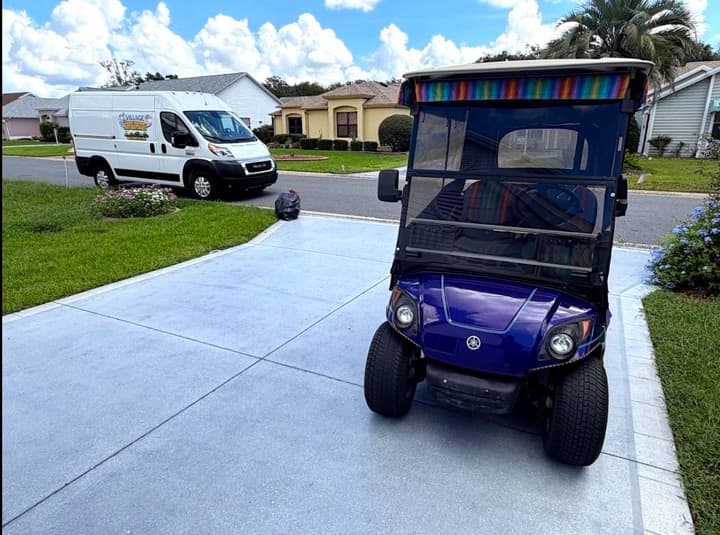
With more than 85,000 golf carts on the road here, The Villages runs on a set of rules that new residents (and even some longtime ones) get wrong more often than you'd think. Here's what actually matters, in plain terms.
The speed limit rule that decides everything
The simplest way to think about it: a standard golf cart can only be driven on roads with a posted speed limit of 30 mph or less. That's it. That one number decides almost every question people ask me.
That means roads like US-441/27, CR-466, and CR-466A, all of which run 35 mph or higher, are off-limits to a standard cart. You are not supposed to drive across them, even quickly, even if traffic looks clear.
So how do you get across those roads?
That's what the tunnel and bridge system is for. The Villages has more than 100 miles of multi-modal paths and over a dozen dedicated golf cart tunnels and bridges built specifically so carts can cross the busier roads safely, underneath or over the traffic instead of through it. If you're new here, learning your tunnel routes is worth doing before you learn much else about getting around.
One exception residents ask about a lot: there is a single at-grade, traffic-light-controlled crossing of El Camino Real between Enrique Drive and Botello Avenue. That's the rare spot where you're crossing at street level with a signal, not through a tunnel.
Heads up if you own a taller cart or one with an aftermarket lift or roof: some of the tunnels have clearances as low as 70 inches. If your cart has been modified, it's worth double-checking clearance before you assume every tunnel will fit it.
Standard golf cart vs. a Low-Speed Vehicle (LSV)
A lot of the confusion in The Villages comes from mixing these two up.
A standard golf cart tops out around 20 mph, doesn't require a license, registration, or insurance, and is restricted to those 30-mph-and-under roads and the cart paths.
A Low-Speed Vehicle (LSV) is a different legal category. LSVs can go up to 25 mph and are allowed on roads posted up to 35 mph, but they require a valid driver's license, state registration, and insurance, just like a car. If you've ever wondered why your neighbor's cart has a license plate and yours doesn't, that's the difference.
Lights and basic equipment
Headlights are required from 30 minutes before sunset to 30 minutes after sunrise. Drivers must be at least 14 years old. If your cart's lights are out, dim, or were never wired correctly after an aftermarket upgrade, that's a quick and inexpensive fix, and one I'd rather you handle before dusk than find out about it in a tunnel.
Why this matters for keeping your cart running, not just legal
Understanding these rules isn't just about avoiding a ticket. Carts that get pushed onto higher-speed roads or driven through tunnels they don't clear take more wear on suspension, tires, and body panels than carts that stay in their lane, so to speak. Knowing your routes protects your cart as much as it protects you.
Need a hand with this?
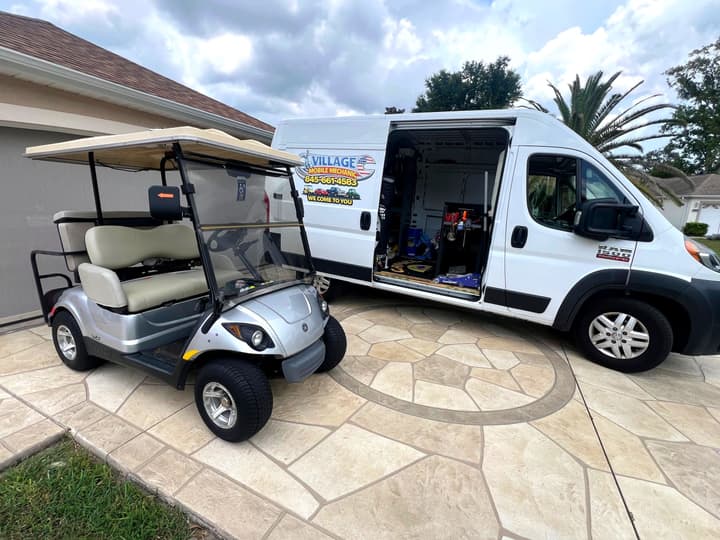
Whether it's a lighting fix so you're legal after dark, a clearance question about a modified cart, or a full inspection before cart season ramps back up, Village Mobile Mechanic comes to your driveway anywhere in The Villages. Give me a call and we'll get it sorted.